Saturday, November 2, 2013

Why Guilt and Shame Don’t Work

Why does it seem that for many their first reaction to an overweight person is to point out their size and attempt make them feel bad for being so “fat and lazy?” When asked why they do this, most people answer that they are simply trying to motivate the person into wanting to lose the weight. I've seen countless pictures online of overweight and obese individuals and there will always be at least one comment from someone ridiculing the person in the image simply for the perceived crime of being overweight. And it only seems to be getting worse. As the internet becomes more popular and populations swell, more pictures than ever are being posted.
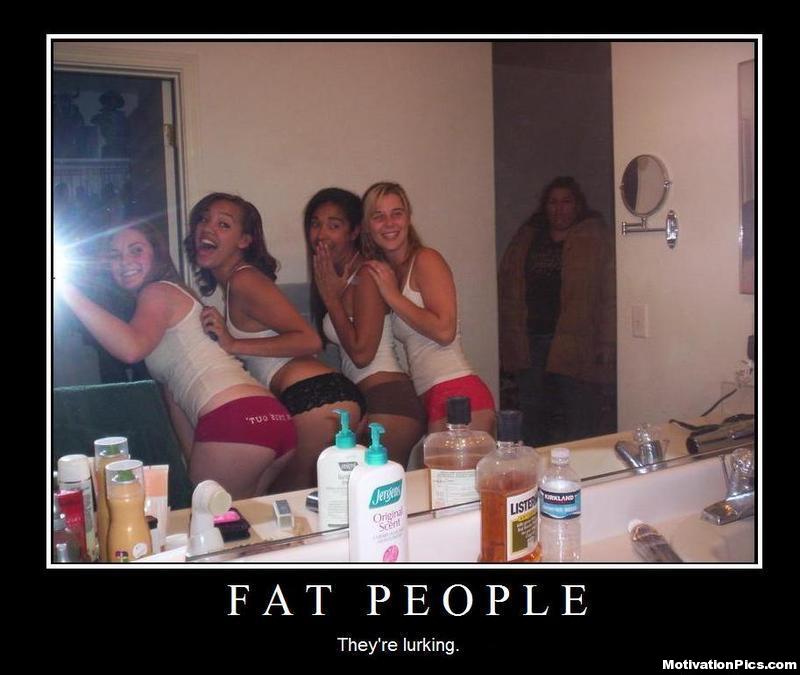
An example that has been circulating online for a while now, usually accompanied by comments about the girl on the far right's appearance.

The internet isn't the only one to blame. Fat-shaming has been going on for years. It just has been made a lot easier because you can hide behind your computer, sometimes with an identity that is not your own, and point and laugh at those whose appearance you feel is in some way is objectionable to you. Of course, it doesn't always happen behind the safety of your electronic device. I hear it everywhere I go. Most of the time, those that I overhear are not talking about me. But that doesn't make it any better. If you feel that way about that person, you probably feel contempt towards me as well.
Yet obesity is more rampant that ever. According to Gallup, “More than 6 in 10 American adults (63.1%) were either overweight (36.6%) or obese (26.5%) in 2009” (Mendes). In 2010, the CDC reported that the number of obese was at 35.7% (U.S. Department of Health and Human Services 1). Clearly, making people feel ashamed is not proving to be an effective method of motivating anyone to lose weight. In fact, it seems to do more harm than good.
One of the reasons that humiliation and shame don’t work is that stress raises levels of cortisol, a hormone in the body that is released when we are under stress. Cortisol is released as part of our “fight-vs.-flight” response in the body, but unfortunately, the body was not built to be under high levels of stress for long periods of time. Over time, cortisol actually causes more of the fat we eat to be stored in the body. And it gets stored in one of the worst places: the stomach. When fat is deposited here, professionals often refer to it as “toxic fat” because the buildup of fat in this area is often related to heart disease and stroke (Stöppler).
To add to the problem, a lot of people take comfort in eating when they are upset. We tend to soothe our frayed nerves and broken spirits with ice cream, candy, potato chips, and pizza. I have never heard anyone say, “I am so depressed that I think I’ll have the broiled tilapia with steamed broccoli and a side of brown rice,” although that would probably be a better choice. Instead, we are drawn to calorie-dense comfort foods. Some even cope by throwing back a few alcoholic beverages, many of which are notorious for being laden with a ton of calories.
When we are stressed, we also tend to devote less time to eating. “I just want to grab something to eat and go to bed/watch a movie/play some video games.” So we end up at some drive-thru picking up a combo meal or standing in front of the microwave zapping a processed food product. Rarely do these offer much in the way of nutritional value but never fail to fill us with simple carbs and saturated fat. Clearly, opening your mouth to make someone feel ashamed of themselves has the opposite effect.
What makes matters worse is that at the same time people are slinging insults and trying to tear us down, our brain is telling us we need to eat. We have been conditioned by our evolution to crave fat, sugar, salt, and carbs. While in excess all of these can have detrimental effects, in moderation they are important. They help our bodies carry out their most basic functions. There was once a time fat, sugar, salt, and carbs were in short supply. We had to hunt and gather. We had to eat extra in the more plentiful times so we could survive long cold winters where food was scarce. We went to great lengths just to stay alive. However, during our human history we figured out how to increase our supply of food through agriculture and technology (Leith). Unfortunately, our brains have not evolved as quickly as we have advanced technologically. While the world is telling us to feel ashamed for craving salty, fatty, and sugary foods, or brain is giving us the opposite message.

So what can be done to change this? I’m not sure. If you’re reading this and you are one of those folks who likes to ridicule those who are overweight and obese, stop. It’s not easy, but it needs to end. Realize that your words are a powerful weapon that can cause years of pain. Even if you think you’re just kidding around and the recipient of your barbs is “okay” with your insults (sometimes they aren't; they just say that to be “cool” with you), think again. I’m not trying to change the world overnight or be a “party-pooper,” but we need to change our mindset. Insults really don't help anyone.


Works Cited
Leith, William. "Evolution Makes Us Fat." Telegraph.co.uk. Telegraph Media Group Ltd., 27 Sept. 2007. Web.
Mendes, Elizabeth. "Six in 10 Overweight or Obese in U.S., More in '09 Than in '08." Gallup Well-being. Gallup, Inc., 9 Feb. 2010. Web.
Stöppler, Melissa Conrad, MD. "Stress, Hormones, and Weight Gain." MedicineNet. Ed. William C. Sheil Jr., MD, FACP, FACR. 27 Feb. 2007. Web.
U.S. Department of Health and Human Services. Centers for Disease Control and Prevention. Prevalence of Obesity in the United States, 2009-2010. By Cynthia L. Ogden, Ph.D., Margaret D. Carroll, M.S.P.H., Brian K. Kit, M.D., and Katherine M. Flegal, Ph.D. Hyattsville, MD: National Center for Health Statistics, 2012. No. 82. Web.

Sunday, June 9, 2013

The past several months have been a maddening struggle. I went from 2100 calories around the beginning of the year to 1900, then 1700, 1500, and for the past month, 1300. I increased workouts from 3 times a week to 6. I rarely ever use elevators and escalators (except for the short period of time when I stubbed my toe so bad I actually thought it was broken). Sometimes the hunger gives me a headache. I get one once a day. So I don't understand why I can't lose a single pound. I'm exhausted of measuring, weighing, writing every calorie down, putting up with criticism that I'm obsessed and a fanatic, yet getting absolutely nothing in return. I don't have a family doctor who could maybe help or understand. I'm terrified about what this obesity is doing to my body in the long run. People look at me and assume I'm a lazy slob and it hurts. I just need this to start working.

Thursday, May 16, 2013

So it happens again.

I am doing well. I'm working out on a regular basis. I'm finally losing weight, even if it is only a few pounds. It doesn't matter that it's only a few pounds because I'm on the right track.

But then my back goes out. Not the end of the world, right? It'll last a few days and I'll be back to normal. No problem. It's a setback. I'll feel like I have to start over with my workouts. The injury somewhat resets all the progress I had made. I'll gain the weight back and maybe a little more because I'm immobile and unable to prepare healthier meals.

But it keeps happening. Again and again and again. For years. The weight gain is starting to really add up and exacerbates the back pain making the episodes longer and more painful. Longer episodes of incapacity mean bigger setbacks, longer periods of minimal exercise, and greater weight gain. The cycle continues over and over.

I lose my insurance and can't find a job that offers insurance. The state says I'm not eligible for benefits and refers me to the clinic. The clinics insist that I apply for benefits. Meanwhile, I'm stuck here alone and isolated on a heating pad filling out form after form hoping this time I'll be covered so I can continue physical therapy (and get the lesions biopsied so I don't have to worry anymore, but that is another issue). My condition negatively impacts every aspect of my life from my job to housework to maintaining a social life.

So please forgive me if I get angry when someone says they don't understand why this is so upsetting. Or when people question the cleanliness of my home or my ability to go to work. Or when I'm asked why I LET it get this bad.

Saturday, February 2, 2013

On Being Myself

Recently I told a Facebook friend I liked the same band that she did. In fact, I really liked the same exact YouTube video she posted and told her so. In a roundabout way she told me that I indeed was not a fan of the band and was only saying so to be likable.

I was taken aback. I didn't know what to say. I wasn't sure if I am offended or confused. (I already talked with her about the issue and she said it was a misunderstanding. She said is cool with me posting this because I'm not mentioning her name.)

In another situation when I told someone I was insecure about something they told me to knock it off and be myself. I was confused. I was being myself.

I am writing about this because this has happened before. Many times. Not so often that it happens every moment of every day, but enough to become quite aggravating.

It seems that people run around posting "be yourself" on Facebook walls, bumper stickers, and T-shirts. However, I don't think that most people understand what "being yourself" really is. The average person that I meet tells me I'm not being myself when my personality traits or opinions are not what they expect they should be.

"You're not a goth. That's not you."

"You're not depressed. You're just pretending to be depressed and that's not you."

"You don't really like that band that I like. Why can't you just be yourself!?"

But I am being myself. Just because I don't fit a certain profile or assumption of who you think I am doesn't mean I am not that person.

And while I am on the subject, people only seem to accept "being yourself" when you have certain traits that are popular. If you are an introvert, a wallflower, a cutter, a bookworm, etc. then you aren't being yourself. If you are outgoing, popular, cheerful, exciting, daring, and so on then you are being yourself. There's nothing wrong of course with being outgoing, popular, etc. Those are wonderful personality traits, but they aren't for everyone. Some people love to get dressed up and party until the wee hours of the morning, while others prefer pajamas and video games until the sun comes up. Neither is more preferable to the other and some people enjoy both situations from time to time.

I'm sorry if this doesn't make sense. It's confusing to explain. But when people tell me to be myself (when I already am being myself) it seems like they are encouraging me to be what they expect out of me. I am what I am. I might change over the years (I'm not the same metalhead I was when I was in my early teens, for example, but still enjoy the genre), but I can assure you that I am being who I am. For example, sometimes I am over-enthusiastic or over-eager. That's not me trying to be someone I'm not. It's just who I am. When I discover something new like a song or movie that I really like I get totally obsessed with it (The Avengers movie is a good example). That's just who I am. Sometimes that trait is a good thing like when it comes to school--I get totally absorbed with my subject material, especially early in the semester and read an study as much as I can. Of course, it's not always a good trait, but we all have things about us that aren't perfect.

I am still a work in progress. We all are. But I can assure you that I am being myself.

If you're reading this and you think you can provide a better explanation of what I'm trying to say, please feel free to share your thoughts!