Why does it seem that for many their first reaction to an
overweight person is to point out their size and attempt make them feel bad for being so “fat and
lazy?” When asked why they do this, most people answer that they are simply
trying to motivate the person into wanting to lose the weight. I've seen
countless pictures online of overweight and obese individuals and there will
always be at least one comment from someone ridiculing the person in the image
simply for the perceived crime of being overweight. And it only seems to be
getting worse. As the internet becomes more popular and populations swell, more
pictures than ever are being posted.
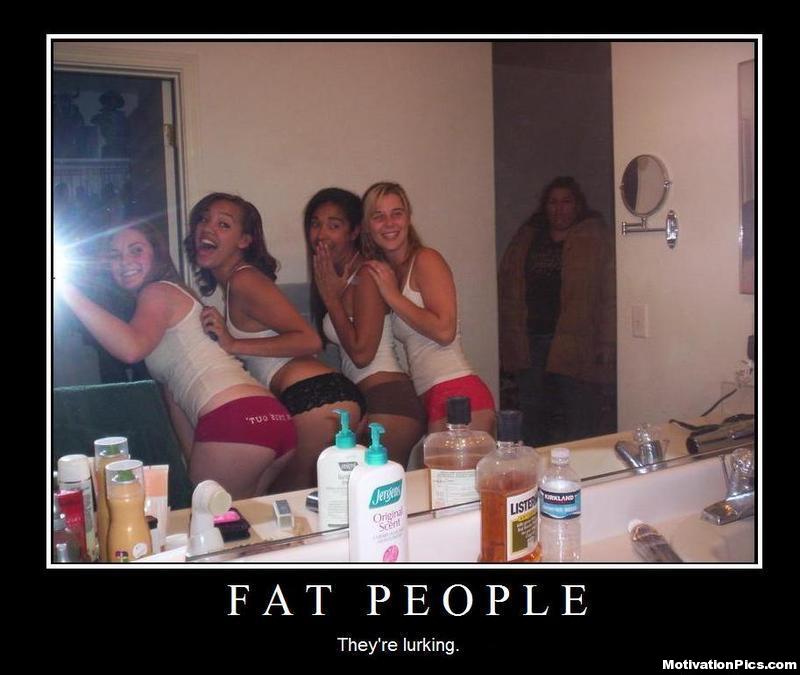 |
| An example that has been circulating online for a while now, usually accompanied by comments about the girl on the far right's appearance. |
The internet isn't the only one to blame. Fat-shaming has been
going on for years. It just has been made a lot easier because you can hide
behind your computer, sometimes with an identity that is not your own, and
point and laugh at those whose appearance you feel is in some way is
objectionable to you. Of course, it doesn't always happen behind the safety of
your electronic device. I hear it everywhere I go. Most of the time, those that
I overhear are not talking about me. But that doesn't make it any better. If
you feel that way about that person,
you probably feel contempt towards me as well.
Yet obesity is more rampant that ever. According to Gallup, “More
than 6 in 10 American adults (63.1%) were either overweight (36.6%) or obese
(26.5%) in 2009” (Mendes) .
In 2010, the CDC reported that the number of obese was at 35.7% (U.S. Department of Health and Human Services 1) . Clearly, making
people feel ashamed is not proving to be an effective method of motivating
anyone to lose weight. In fact, it seems to do more harm than good.
One of the reasons that humiliation and shame don’t work is
that stress raises levels of cortisol, a hormone in the body that is released
when we are under stress. Cortisol is released as part of our
“fight-vs.-flight” response in the body, but unfortunately, the body was not
built to be under high levels of stress for long periods of time. Over time,
cortisol actually causes more of the fat we eat to be stored in the body. And
it gets stored in one of the worst places: the stomach. When fat is deposited
here, professionals often refer to it as “toxic fat” because the buildup of fat
in this area is often related to heart disease and stroke (Stöppler) .
To add to the problem, a lot of people take comfort in eating
when they are upset. We tend to soothe our frayed nerves and broken spirits
with ice cream, candy, potato chips, and pizza. I have never heard anyone say, “I
am so depressed that I think I’ll have the broiled tilapia with steamed
broccoli and a side of brown rice,” although that would probably be a better
choice. Instead, we are drawn to calorie-dense comfort foods. Some even cope by
throwing back a few alcoholic beverages, many of which are notorious for being
laden with a ton of calories.
When we are stressed, we also tend to devote less time to
eating. “I just want to grab something to eat and go to bed/watch a movie/play
some video games.” So we end up at some drive-thru picking up a combo meal or
standing in front of the microwave zapping a processed food product. Rarely do
these offer much in the way of nutritional value but never fail to fill us with
simple carbs and saturated fat. Clearly, opening your mouth to make someone
feel ashamed of themselves has the opposite effect.
What makes matters worse is that at the same time people are
slinging insults and trying to tear us down, our brain is telling us we need to
eat. We have been conditioned by our evolution to crave fat, sugar, salt, and
carbs. While in excess all of these can have detrimental effects, in moderation
they are important. They help our bodies carry out their most basic functions.
There was once a time fat, sugar, salt, and carbs were in short supply. We had
to hunt and gather. We had to eat extra in the more plentiful times so we could
survive long cold winters where food was scarce. We went to great lengths just to
stay alive. However, during our human history we figured out how to increase
our supply of food through agriculture and technology (Leith) . Unfortunately, our
brains have not evolved as quickly as we have advanced technologically. While
the world is telling us to feel ashamed for craving salty, fatty, and sugary
foods, or brain is giving us the opposite message.
So what can be done to change this? I’m not sure. If you’re
reading this and you are one of those folks who likes to ridicule those who are
overweight and obese, stop. It’s not easy, but it needs to end. Realize that
your words are a powerful weapon that can cause years of pain. Even if you
think you’re just kidding around and the recipient of your barbs is “okay” with
your insults (sometimes they aren't; they just say that to be “cool” with you),
think again. I’m not trying to change the world overnight or be a “party-pooper,”
but we need to change our mindset. Insults really don't help anyone.
Works Cited
Leith, William. "Evolution Makes Us Fat." Telegraph.co.uk. Telegraph Media Group Ltd., 27 Sept. 2007. Web.
Mendes, Elizabeth. "Six in 10 Overweight or Obese in U.S., More in '09 Than in '08." Gallup Well-being. Gallup, Inc., 9 Feb. 2010. Web.
Stöppler, Melissa Conrad, MD. "Stress, Hormones, and Weight Gain." MedicineNet. Ed. William C. Sheil Jr., MD, FACP, FACR. 27 Feb. 2007. Web.
U.S. Department of Health and Human Services. Centers for Disease Control and Prevention. Prevalence of Obesity in the United States, 2009-2010. By Cynthia L. Ogden, Ph.D., Margaret D. Carroll, M.S.P.H., Brian K. Kit, M.D., and Katherine M. Flegal, Ph.D. Hyattsville, MD: National Center for Health Statistics, 2012. No. 82. Web.


No comments:
Post a Comment